Details
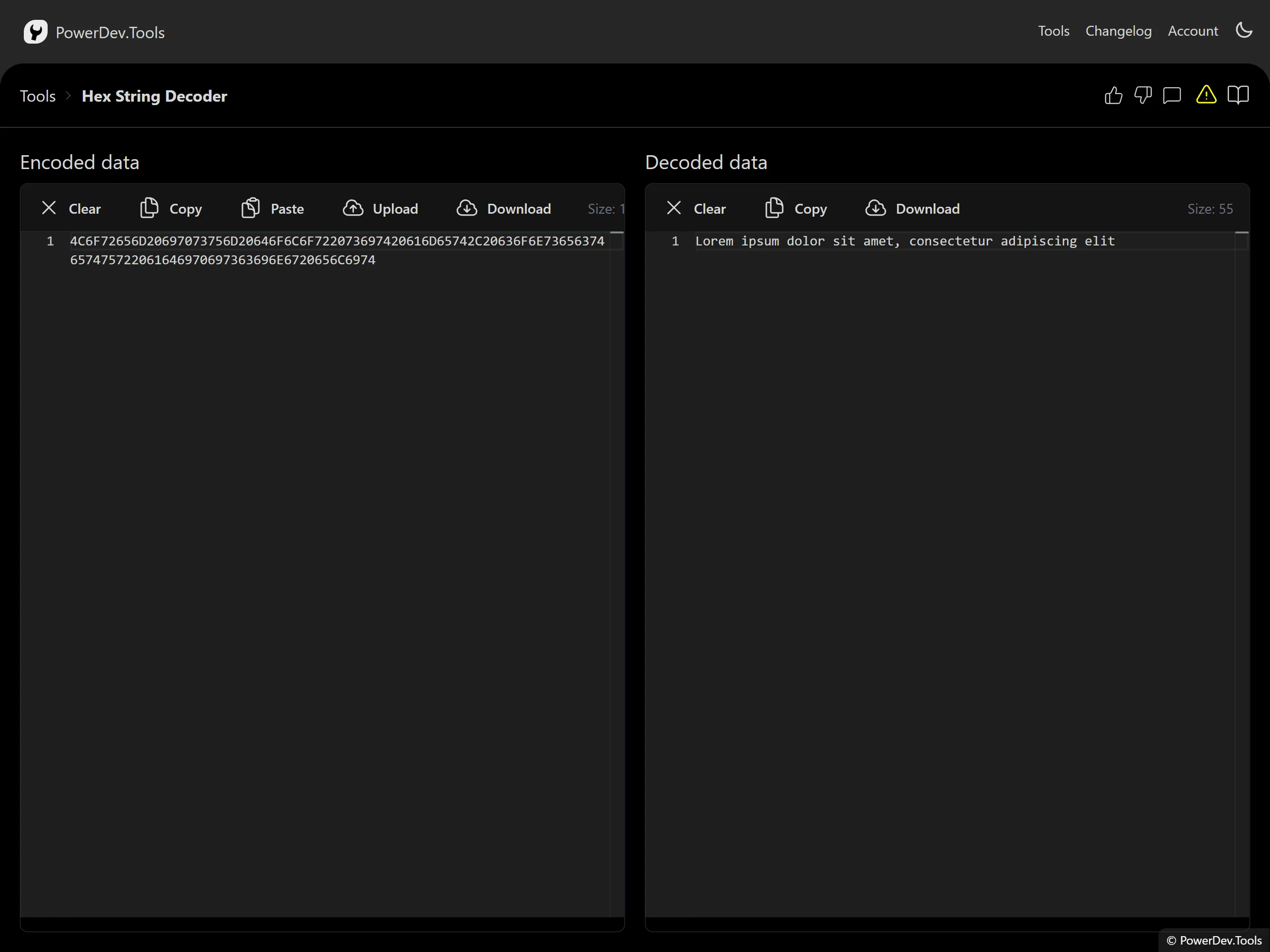
Hex string decoding reverses the encoding process, converting pairs of hexadecimal characters back into their original byte values and then interpreting them as text.
The decoder ignores all whitespace characters — spaces, tabs, newlines, and carriage returns — so you can paste hex data from any source regardless of formatting.
For example, both 48656C6C6F and 48 65 6C 6C 6F decode to Hello.
Hex encoded data is commonly found in debugging output, network packet captures, log files, and low-level programming contexts.
Hex encoding produces a 2× size increase compared to the original data. For more compact binary-to-text encoding, Base64 achieves roughly a 4:3 ratio. For encoding text with only a few non-ASCII characters, Quoted-Printable is usually more efficient.
Hex encoding IS NOT an encryption algorithm — it is a simple, reversible data representation providing absolutely no protection!
Looking to encode text to hex instead? Use the Hex String Encoder.
