Details
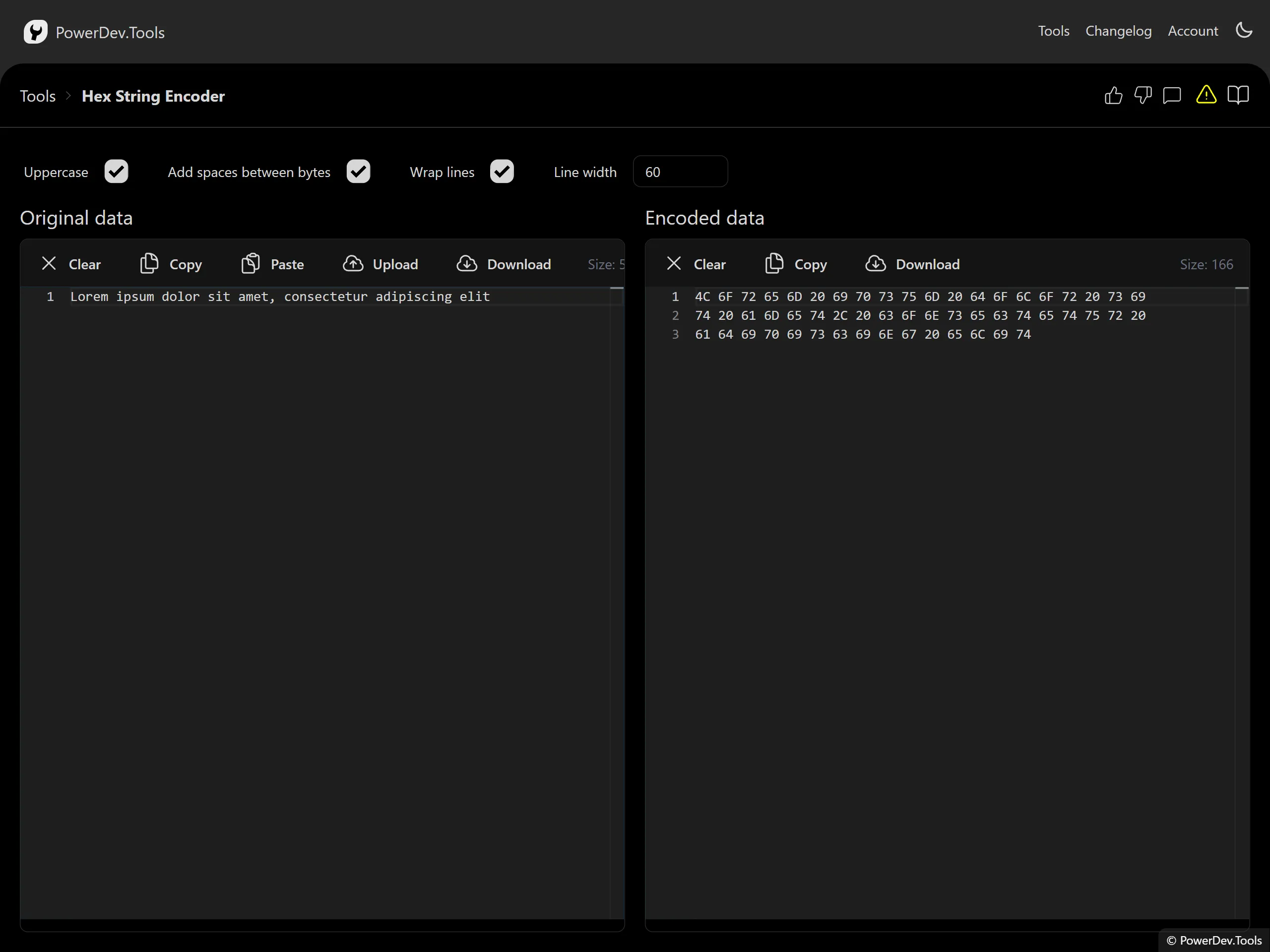
Hex string encoding converts each byte of text data into its two-character hexadecimal representation (00–FF). This produces a plain ASCII string that is safe to use in contexts where raw binary data is not allowed.
For example, the text Hello encodes to 48656C6C6F.
Options include adding spaces between hex byte pairs for readability (e.g. 48 65 6C 6C 6F) and wrapping
output lines at a configurable width.
Hex encoding is commonly used in debugging, network protocol analysis, low-level programming, and data inspection. It is straightforward but verbose — each input byte becomes two output characters, resulting in a 2× size increase.
For more compact binary-to-text encoding, consider Base64 Encoder which achieves roughly a 4:3 ratio. For encoding text with only a few non-ASCII characters, Quoted-Printable is usually more efficient.
Hex encoding IS NOT an encryption algorithm — it is a simple, reversible data representation providing absolutely no protection!
Looking to decode hex strings instead? Use the Hex String Decoder.
